Wildfires.org for the US Forest Service
Context. A three-year federal operations platform delivered across agencies, contractors and a team of 30 people at peak.
Result. $6M program delivered on time and within budget. The planning process runs 60% faster, so plans clear their window instead of missing it.
$6M
program budget
60%
faster planning
150k
documents in the AI corpus
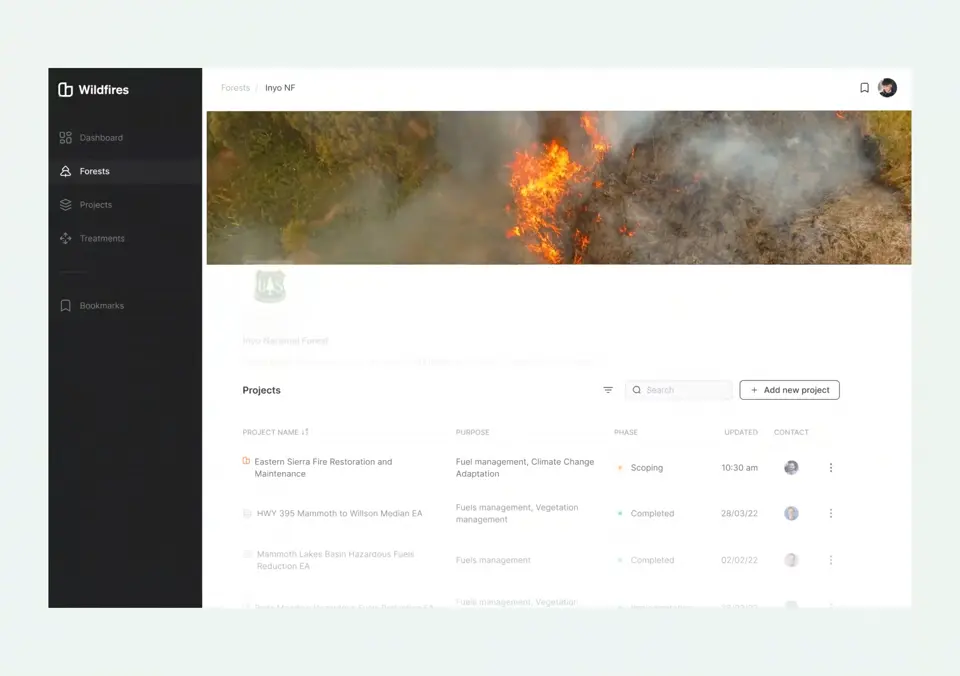
Context. An end-to-end operations platform for the US Forest Service: project planning, contractor collaboration, documentation, a library of form and project templates, Gantt scheduling, and team and workload management. Work is map-based - a task can be pinned to an area of forest, and a ranger in the field can report a problem against a location and have it appear on the same map.
The problem. Forest management plans moved through a slow, paper-era approval process. When a plan missed its window, the preventive work it authorised did not happen - and the cost of that delay is measured in wildfires, not in missed deadlines. On top of that: coordination across multiple agencies, a hybrid Fixed Price / T&M commercial model, and a three-year timeline where slippage carried formal consequences.
What I did. Owned scope, budget, timeline and risk end to end for three years. Scaled the team to 30 people at peak. Ran delivery across agencies and contractors while keeping the commercial model intact.
One module of the platform was dedicated to AI. We built a retrieval system over roughly 150,000 forest service documents that did three jobs: it normalised document formats that had drifted apart over decades; it resolved the dependency web between forms, so a single action that required six interlocking documents could be completed in one pass instead of six separate ones; and it pre-filled fields from what the documents already knew - a tree removal form could offer the species actually present in that forest as a dropdown, instead of a blank field and a trip to the archive.